I began my career as a professional photographer. Well, in a sense. My friend Joel had jerry-rigged a darkroom in his basement, and had bought equipment, including a used enlarger, at a local camera shop, and we started going to football games and other school events with our cameras, offering to take photos of our classmates (usually couples) and bring them freshly made prints of the best shots. I can't remember how much we charged, but we offered options: 5x7, 8x10, pocket-sized.
It was really Joel's gig, his idea and his equipment; I was merely his assistant. But I learned a lot, in those days, about how to develop photographs, what kind of paper to use, how to get the best levels of contrast, how to judge the moment to remove a print from the developer and drop it in the fixer. And I spent a lot of time practicing my picture-taking skills, learning how to vary exposure and shutter speed to achieve different effects. I thought a great deal about composition and flattered myself that I could find an interesting framing of an undistinguished scene.
Joel and I loved that little camera shop out on Roebuck Parkway, and I think the owner, who had an impressive selection of used cameras and other equipment, was sufficiently pleased to see a couple of teenagers haunting his shop with such ardor that he cut us some deals. Joel had a Minolta SLR, if I remember rightly, but I decided that I really wanted a Rolleiflex. Those were considered wildly out of date at that time, but something about it — the square format, the larger negative, composing by looking down into a viewfinder — was deeply appealing to me. Very few people took square photos in those days, and would not until Instagram came around, but I've preferred that format for more than fifty years now.
About one thing Joel and I were purists: we worked only in black-and-white, and took almost all of our pictures on Tri-X Pan. The people to whom we sold our photos always wanted color, and I don't think we could have explained to them the depths of our commitment to monochrome, so we just told them that color photos would be more expensive. (And indeed Joel probably couldn't have afforded the equipment to make color prints; I certainly couldn't have.) But even if we could have afforded colors we would have declined the use of it, on principle.
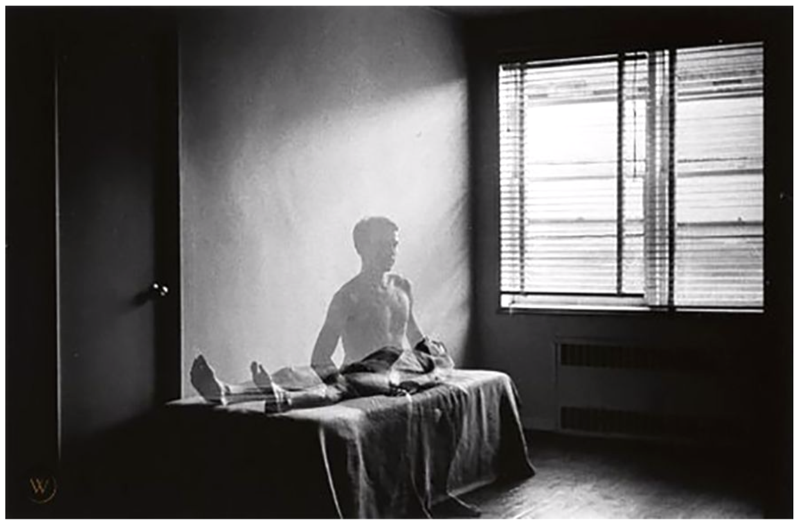
We spent hours and hours poring over the books of and about photography that we checked out from the East Lake Public Library, and developed a pantheon of heroes: for Joel Ansel Adams was the king of kings, but I preferred Edward Weston. (Weston was the right role model for a guy with a Rolleiflex.) We were not hidebound traditionalists — we spent a lot of time trying to reproduce some of the double-exposure effects of the great experimentalist Duane Michals — but were were traditionalists.
When I was sixteen I discovered the work of Cartier-Bresson, and from that moment no other photographer could compete for my devotion.
I traded in my Rolleiflex for a Pentax SLR — no Leicas were within my price range, and in any case I feared that I would be unable to master the art of shooting with a rangefinder. But I discovered that if there were appropriate subjects for Cartier-Bresson-like photographs in Birmingham, Alabama, I didn't know how to find them. I grew discouraged, and eventually became a mere shooter of snapshots.
But allowing serious photography to pass out of my life, mostly, was, I now think, a mistake. I'm still, I think, a better-than-average snapshooter, but in my retirement I really want to become a photographer again. We'll see whether I manage it.
P.S. A cool guy with his Rolleiflex, even if the gentleman behind him isn’t impressed:
First, some perspective. As I have written on several occasions — I say that in case some of you think “Wait, I’ve heard this before” — one of my most regular riffs for my students goes like this: A number of years ago I met a woman from Kingston, Jamaica who in her high school days had won a prize for Best English Essay. That prize was given her by a visiting dignitary, who happened to be T. S. Eliot. T. S. Eliot’s paternal grandmother, Abigail Adams Eliot, clearly remembered her great-uncle, John Adams (for whose wife she was named). And when John Adams was a young man in Paris, he met Voltaire, a man born in the 17th century.
You can get back to what we think of as the distant past in a hurry: to the 17th century in six steps. This is one of the chief reasons why Gavin Stevens, the character who serves as a kind of stand-in for Faulkner in the Snopes trilogy, is right to say that “The past is not dead; it is not even past.” Our history reverberates into our present. The fathers have eaten sour grapes and the children’s teeth are set on edge; so says the Word of the Lord.
That’s the first thing you have to know to understand the American South. The second thing you need to know is that the white South is a clan-based social order, in which “my people,” “our people,” are almost everything. To understand why this is, reflect on the point about history I have just made and then read the “Borderlands to the Backcountry” chapter of David Hackett Fisher’s Albion’s Seed.
If any non-Southerner confronts a white Southerner about the evils of slavery and, later, Jim Crow, the replies are selected from a very small pool. “Why don’t you worry about the evils of your own history?” “Slavery wasn’t nearly as bad as you people make out.” “Of course there were some nasty racists and cruel slave-owners, but most people got along just fine.” Or, the maximal concession: “Sure, our society had problems, but we were working on them and would’ve gotten everything straightened out eventually if the Yankees had left us alone.” But underlying all this is a deeply embedded, so deep it only rarely finds expression, and nearly universal reaction: “How dare you suggest that your people were morally superior to my people?” (Fisher on the common perception of immigrants to Philadelphia from the Borders in the early 18th century: “The speech of these people was English, but they spoke with a lilting cadence that rang strangely in the ear. Many were desperately poor. But even in their poverty they carried themselves with a fierce and stubborn pride that warned others to treat them with respect.”)
It’s the old human story: We want to judge others according to an absolute standard, and to judge ourselves in comparison to others. (“We’re not any worse than you.”) I will now set aside the comparative questions and say this: the Old South — the South of my ancestors, for all my people for ten generations back or more are Southern — was not in any sense a land of chivalry and honor and Stoic resolution; it was instead a land of profound moral depravity. The depravity was never absolute, and it was accompanied by virtuous people and practices, but it was pervasive. The everyday horrors of slavery have been amply documented by the slaves themselves as well as by their owners, who were often proud of their cruelty; it is only within my lifetime that a white man could reliably be convicted in court for raping a black woman or for killing a black man — or, indeed, for killing a white man who tried to protect a black teenage girl; there are people alive today who still remember an era when, throughout the South, lynchings would be scheduled in advance, advertised in the newspapers, and attended by hundreds or even thousands of delighted spectators. None of these actions was universally approved; none was uncommon or atypical either. They were ordinary events, ordinary experiences, in a sick society, a twisted and perverse culture. That there have been even more corrupt societies in human history is not to the point. No morally sane person would want to restore such a society in any form.
When I say things like this, some people reply that I am “ashamed” of being a Southerner or — as Shreve McCammon accuses Quentin Compson at the end of Absalom, Absalom! — that I hate the South. I am speaking the simple truth when I say that I do not understand these statements. I don’t get the concept of being ashamed, or for that matter proud, of the place you were born. (I feel the same incomprehension when people say they’re “proud to be an American.”) I feel proud of my son when he exhibits good character — as he often does — and of my wife when she is kind and compassionate towards those in need — as she regularly is. I feel pleased and satisfied when I have done good work. I am often ashamed when I reflect on the long list of sins and stupidities I have amassed in my life. But I do not know what it would even mean to be either proud or ashamed of being a Southerner, nor can I grasp the idea of “hating” the South. “The South” is comprised of a million things, some of which I admire, some of which I detest, some of which make me laugh — and all of which are in one way or another constitutive of me.
I am at ease in a world that has a good many black people in it, simply because I grew up in such a world. It feels justly proportioned, whereas the almost exclusively white world I lived in for decades in Wheaton, Illinois never ceased to feel unbalanced to me. Similarly, even though I now live in Texas I continue to think that the normal things to barbecue are pork shoulder and ribs, and if you were to tell me that you had recently eaten fish the image that would come to my mind is cornmeal-battered catfish. While I admire beyond measure the great Scotch whiskies, a fine bourbon sings the song of my heart. It would be slightly embarrassing to count how many books about the Beatles I have read, and I listen to their records all the time, but there are vast regions of my soul that they cannot touch, that belong instead to Waxahatchee singing Lucinda Williams’s “Fruits of My Labor” or Leon Bridges singing “River” or Emmylou Harris singing “From Boulder to Birmingham.” Ralph Stanley: “O Death.” Going even further back: the Carter Family’s “Wildwood Flower,” though I admit to a special love for Bill Frisell’s instrumental version. Louis Armstrong — the roots are plunging very deep here — playing and singing “St. James Infirmary.” The world of contemporary Christian music is alien to me, but a few months ago at Laity Lodge Sandra McCracken sang “All Ye Refugees” and it went straight through me like a knife. That’s gospel — that’s the Gospel, and in a mode that resonates with generations of my DNA. I am helpless before it; your own sensibilities may be too refined for such an experience, I can’t say.
The literature of the South, especially its mid–20th-century Renaissance, was central to me once — when I was twenty I thought Absalom, Absalom! the finest novel in the world, and Flannery O’Connor the English language’s greatest writer of short stories — but to my regret I must admit that my deep fascination with such works has not lasted. I return to them rarely, though I still admire them, and maybe in my old age they’ll be meat and drink to me again. Oddly enough, I may have come to them too late, because in my most impressionable years (thirteen to eighteen) I was reading Loren Eiseley and Ursula K. Le Guin and was beginning my love affair with England and English literature, and those encounters transformed my mind. In college I started reading Sir Thomas Browne because I had been told that he was an influence on Faulkner, but soon found that I greatly preferred Browne to his Mississippian admirer. His Englishness and his Christianity alike attracted me, and from that point on I would draw little intellectual or literary nourishment from my fellow Southerners. Not none — Walker Percy remained and remains a strong, wry voice in my head — but little.
(Wendell Berry I think of more as a farmer than a Southerner: his personal kinship is with the people who dwell in the Kentucky River valley and his intellectual kinship is with people from elsewhere — Wes Jackson, Gary Snyder — who share his agricultural sensibility, his gratitude for “the gift of good land.”)
The plain fact is, I would trade the whole Southern literary tradition, wincing at the departure of Lost in the Cosmos, for The Lord of the Rings or Middlemarch or the theology of Richard Hooker and Jeremy Taylor. I admit to making this a little easier for myself by seeing my fellow Alabamian and prime culture-hero Albert Murray as something other than a “Southern writer” as that phrase is usually defined.
And I sometimes wonder whether the intellectual and moral life of the white South would be stronger and healthier today, less prone to recrudescences of bigotry and moral corruption, if more Southerners had followed Murray’s example and looked beyond their own intrinsic cultural resources to a broader world that could help expand the range of their thoughts, their sensibilities, and their sensitivities. They could have started by consulting their black sisters and brothers. (The blues is country music and therefore, at one remove, so is jazz. Even Ornette Coleman, maybe especially Ornette Coleman, is playing the blues.) Much — not all, but much — of white Southern culture today is a crass and parochial thing, lacking sufficient input from the Wise of other parts of the world and from the Wise of its own past. Through its lack of broad knowledge and sympathies it has made itself increasingly vulnerable to hucksters, so that now its belligerent credulity is nearly absolute.
The food, the music, the vast pine forests, the big slow rivers, the long low ridges that divide the valleys there at the Southern terminus of the Appalachians — this is the South of my dreams and my imagination. All these have marked me deeply and continue to nourish me. But my primary loyalties, I find now, as my seventh decade nears its end, are with the Republic of Letters and, above all, with my fellow Christians wherever they are found. I am grateful for so much of my Alabama upbringing, but my mind is usually elsewhere, and that too is something I am neither proud nor ashamed of.
Those are my thoughts about the South, and about being a Southerner. I said that I’m only going to do this once, but I might have been lying. Time will tell.
Vince Gilligan famously described Beaking Bad as the story of how Mr. Chips turns into Scarface, and the greatness of that show lies above all in the subtle dexterity with which it reveals to us the many incremental choices, no one of which seems decisive, that lead inexorably to corruption and tragedy. It’s a show about how a person changes.
In a pivotal episode of Gilligan’s next show, Better Call Saul, Jimmy McGill learns that his seemingly-certain hiring at Hamlin Hamlin & McGill has been torpedoed by his own brother Chuck. When Jimmy confronts his brother, Chuck is silent for a moment and then explodes:
I know you. I know what you were, what you are. People don’t change! You’re Slippin’ Jimmy! And Slippin’ Jimmy I can handle just fine, but Slippin’ Jimmy with a law degree is like a chimp with a machine gun! The law is sacred! If you abuse that power, people get hurt! This is not a game! And you have to know on some level, you know I’m right. You know I’m right!
“What you were” is “what you are,” because “people don’t change.” And in the end Chuck is right: Jimmy, no matter how many times he vows to clean up his act, lapses. He reverts to the habits of the young Chicago hustler he once was: Slippin’ Jimmy. Saul Goodman, the thoroughly corrupt lawyer we meet in Breaking Bad, is just Slippin’ Jimmy in a snazzy suit and Gucci loafers.
The question the show (brilliantly) leaves open is: Why? Why does Jimmy not change? Is it because there’s a kink in his wiring, there from the beginning? Is it (Chuck seems to think this) because of parental indulgence? Or is it something else? I recall the argument Sartre makes in Saint Genet that Jean Genet, in a kind of revenge on a corrupt society, became exactly what that society had called him: a criminal and a deviant. There’s a good case to be made that when Jimmy realizes that — no matter how hard he works or what he achieves — Chuck will never think of him as anything but Slippin’ Jimmy, he decides: All right, then. Slippin’ Jimmy it is. A decision that has tragic consequences for many people, including Chuck.
But we can’t know — we can never know, because we can’t rewind the tape of a life. We can’t so back to some point that seems to us key, flip a little switch from On to Off or Off to On, and then see what happens when such a change is implemented. Human lives cannot be subjected to double-blind experiments; time prevents it.
The story of a man who does not change might cause us to look again at Walter White in Breaking Bad, because, after all, “Mr. Chips becomes Scarface” is not really Walter’s story at all. When we first see him, on his 50th birthday, he looks like a mild-mannered and slightly boring high-school chemistry teacher, but we soon learn that inside he’s a steaming, smoking cauldron of resentment, wounded pride, and the desire for vengeance. His cancer diagnosis simply allows him to act upon impulses that were already present in him. When we first meet Walter, Scarface is already raging inside him, just waiting for his opportunity to escape.
Do people change? Of course they do — but they never change in ways that make them unrecognizable. Patience can be lost, or gained; the talkative can learn to listen. But when the talkative learn to listen this is, or so I see it, a redirection of energies: the impulse to talk gets channeled differently. Barring some serious physiological alteration, the listless person doesn’t become an energetic one and the energetic one doesn’t become listless. Certain personality traits that, as it were, precede character remain in place, but can be pointed at new targets.
Take my father, for instance. All his days, he was boastful, overconfident, impatient, intolerant of other people’s faults, contemptuous of disagreement. Every single person who knew him really well says exactly the same thing about him: “Carl was an asshole.” But when he was around 60 he started attending Alcoholics Anonymous meetings and soon thereafter became an asshole who had been greatly blessed by the work of AA and wanted to help others receive the same blessing. I’m not sure he had ever in his life — at least not since the death of his little brother Bobby — focused his attention on the well-being of others, but after getting sober he genuinely started doing so. When he died in 2009 and the funeral home hosted the inevitable (and to me much-dreaded) “visitation,” I was utterly stunned at the number of people who showed up. Many of them sought me out and shook my hand and said, “I can’t tell you how much your father meant to me.” Then a pause and a grin. “He sure could be an asshole, though.”
“Yeah, tell me about it,” I thought to myself, though I smiled and nodded, because my sister and I got all the assholery and none of the care. He changed, and yet did not change, one might say; but perhaps it would be better to say that he did not change — and yet changed.
Daddy was sponsor to a number of alcoholics, but the one he was closest to was a man about my age whom I’ll call Nolan. Mama and Daddy used to say to me “You’ve got a brother now” — that’s how close they were, and let me just say that I am pleased and proud to have Nolan as a brother. He’s a great guy.
My parents’ intimacy with Nolan began when I was living hundreds of miles away, in Wheaton, Illinois, and it took me a long time to realize just how close they had become. But after a few years of seeing my parents several times a week, and taking afternoon naps on their sofa, and eating at their table, Nolan drifted away. He didn’t start drinking again, but instead had found a new interest in life — an interest I shall not describe here, because in a certain community Nolan became very well known and if I said what that community is you might be able to figure out his identity. And it’s Alcoholics Anonymous, ain’t it?
In any case, Nolan became so absorbed in his new world that he completely forgot about my parents, who had invested so much time and energy in him, who had watched over him so tenderly. And so their lives diverged and moved on … until something happened to Nolan. He has never told me what that something was, only that it was the biggest challenge he had ever faced in his life, and that he found it impossible to navigate. The ground was moving under his feet, and when that happens to a recovering alcoholic, the temptations are obvious.
Nolan knew precisely what, according to the tenets of AA, he was supposed to do next: Call his sponsor. His sponsor, though, was the one he had turned his back on; and, perhaps even more to the point, his sponsor was the most intolerant, unforgiving asshole he had ever met in his life. He couldn’t possibly call Carl … and yet what other option did he have?
So he called Carl. “Carl, this is Nolan. I know I haven’t seen you and Dolores in a long, long time, and I’m ashamed of that. I feel like I kicked y’all to the curb, and y’all didn’t deserve that. Y’all deserved my love and my gratitude, and I gave you nothing in return, and walked away. You’ve got every right to hang up on me right now, and if you did I wouldn’t blame you. But I’m in a bad place, Carl, and I need your help.”
And Daddy said, “Nolan, son, just tell me what I can do for you and I’ll do it.”
A few days ago we buried my mother in Hopewell Cemetery, Hanceville, Alabama. She lies next to her husband, Carl Edwin Jacobs, who died in 2009 on their fifty-fifth wedding anniversary. Next to them are the graves of my father’s parents, Elisha Creel Jacobs (1902–1971) and Margaret Doran Jacobs (1909–1997).
But why are they all here? Not one of them ever lived a day in Hanceville, and each of them died in Birmingham, where they spent most of their lives.
The answer may be found on a small stone on the opposite side of my grandparents’ graves from my parents’ graves:
Bobby Jacobs — more formally Robert Alan Jacobs — was the second son of Elisha and Margaret, born nineteen months after Carl. I am named for this uncle I never knew, but with the first and middle names reversed. Bobby had a club foot and could never walk properly; my father, who early on assumed the role of Bobby’s chief caregiver, used to pull him around the neighborhood in a wagon. But the club foot was only the first of Bobby’s misfortunes; later he contracted polio and died, a few weeks shy of his sixth birthday.
Immediately after Bobby took his last breath, Carl, then seven years old, did a peculiar thing: he ran straight to the tallest pecan tree in his yard and climbed to the highest branch that would bear him, where he clung, weeping. He remained perched there for hours and hours; no one could talk him down, until, as night fell, someone finally fetched the local Baptist minister, whose authority, maybe, was sufficient to compel Carl to return to the land of the living — and the dead. Or maybe the boy was just worn out.
At the time of Bobby’s death, my grandmother was pregnant with her third child, to be born the following year: Elisha Creel Jacobs, Jr. My father occasionally reminded me that “After Bobby died, your grandmother took to her bed for two years and didn’t lift a goddamn finger.” He despised his mother and, probably because I loved her so intensely, wanted me to despise her too, so when he said this he never mentioned that during those two years, after having lost one child, she had to bear another. Though they didn’t use the word “depression” in those days, much less “postpartum depression,” she must have been profoundly depressed, and that shouldn’t have been difficult for anyone to understand.
(Also worth remembering, perhaps: she was 19 when she gave birth to Bobby, and 25 when he died.)
There’s much I could say about my father, not all of it bad, and I will acknowledge some of the better things on another occasion, but at the moment I am compelled to state that for much of his life he was a shockingly cruel man. When his younger brother E.C. died, in 2000, and E.C.’s ex-wife called my father to give him the news, my father replied “I don’t give a shit” and hung up the phone. I don’t know where this cruelty came from, but I have a strange but persistent intuition that it originated with Bobby’s death — or, rather, emerged in that moment, immediately after Bobby’s death, when instead of grieving with his mother and father he chose to climb that tree and grieve alone, holding his misery as fiercely as he gripped the swaying branch that kept him aloft, high above the human world. This is, I suspect, why even as an old man he was intolerant of his mother’s sorrow at the loss of that same child, the child that she had borne in her own body. It’s my grief, he seemed to say, not ours — and certainly not yours.
My grandfather had many siblings, but the one to whom he was closest, both emotionally and geographically, was the woman we called Aunt B: Bethelee Jacobs Basenberg. She was sixteen years older than my grandfather and I think she must have been a kind of mother to him. (His own mother, when Bobby died, was living in Mississippi, at a time when such distances were harder to bridge. For instance, no one in my family then had telephones, and the roads were often poor. Many of my rural and small-town relatives may not have had electricity in 1934.) I knew her much later, of course, but I remember her vividly: a grand old matriarch who, long after the passing of her husband Mart, still ran their farm. She grew corn mostly, but also had a kitchen garden where she nurtured strawberries and sugar cane, and when we visited she would send me away with grocery bags full of both. One of the vividest memories of my childhood involves sitting at our kitchen table at home and squeezing syrup from her canes over a bowl of her strawberries.
Aunt B’s farm was just outside Hanceville, where she was for many decades a devoted member of Hopewell Baptist Church. Indeed, she is buried in the same cemetery, a few yards from her younger brother, who outlived her by a mere two months.
And now I think we can, with some confidence, piece the story together. When Bobby died, Elisha and Margaret must have turned to Bethelee, that sheet anchor and faithful Christian — they themselves were never more than intermittent churchgoers, nor were their children later — and she must have taken charge of the situation, bringing her nephew’s body to the graveyard next to the church where she worshipped every week. That tiny rectangle with its awkwardly formed epitaph was all that they could afford then, in the depths of the Great Depression, but at least she could watch over the boy’s grave and make sure it was graced with flowers, probably flowers from her own garden.
And then, in time, the rest of the family came to their repose at the same spot — all except poor E.C., the favorite uncle of my youth, whose place of burial, thanks to my father’s mean indifference, remains unknown to me, though I have searched for it. E.C. was a man of many sins and many sorrows, and perhaps some day I will be able to give him, too, a proper tribute.
At the moment, though, I am thinking of the raw red dirt that now marks my mother’s grave, a grave soon to be covered with grass, like the others, all but one of which feature dignified upright tombstones. The larger picture: In the middle, my grandmother and grandfather; to one side of them their eldest son Carl and his wife Dolores; to the other side the child whose death initiated this story, a little boy, misshapen in body and then racked by a vile disease, whose brief life is now marked by a chunk of rock invisible except to the attentive — a little boy who was greatly, greatly cherished, and whose death brought lasting misery to his family.
My father used to say, sneeringly, “Oh, when you were born, Mama thought she had Bobby back, had Bobby all over again.” But Daddy, if you didn’t want her to feel that way, why did you give me his name? You couldn’t have “Bobby all over again” only for yourself.
As I say, we buried my mother yesterday, and to my family I read the beautiful and consoling words of the Book of Common Prayer: “O God, who by the glorious resurrection of your Son Jesus Christ destroyed death, and brought life and immortality to light: Grant that your servant Dolores, being raised with him, may know the strength of his presence, and rejoice in his eternal glory … In sure and certain hope of the resurrection to eternal life through our Lord Jesus Christ, we commend to Almighty God our mother Dolores, and we commit her body to the ground; earth to earth, ashes to ashes, dust to dust. The Lord bless her and keep her; the Lord make his face to shine upon her and be gracious to her; the Lord lift up his countenance upon her and give her peace. Amen.”
But for some reason — perhaps because I have been grieving my mother’s death for some time already — it’s Bobby I am thinking of today. My father lived eighty-two years, my mother ninety-four; Bobby never made it to age six. Now, of course, those gathered in that little country churchyard “accept the constitution of silence / And are folded in a single party.” May light perpetual shine upon them all.
The house my father grew up in is also the house that I grew up in, through age 12. For a while after they married my father and mother lived in their own (rented) house, but soon after I was born they moved back in with his parents. I don’t know the reason, but I assume that, since both my parents worked full-time (when Daddy wasn’t in prison), they could rely on my grandmother to care for me and then, later, my sister. This she did, faithfully and lovingly, and her memory remains a blessing to me and to my sister.
My grandfather was an engineer for the Frisco railroad, and in many respects the railroad dominated my childhood. The freight yard from which he departed on his long runs across the country — the East Thomas Yard — was less than a mile from our house, and Grandma would always take me in her station wagon to drop him off and pick him up. Sometimes, for reasons unknown to me, we would have to drive to Carbon Hill, Alabama to pick him up. (I think crew changes happened there.) On rare occasions his train would rumble slowly into the yard, or depart slowly from it, along a track that ran just a few dozen yards from our house, and when that happened he played a special pattern on his whistle so I would know it was him. When he was disabled by a stroke and forced to retire from the Frisco, a good deal of magic disappeared from my life.
Our house was an old, beat-up, ramshackle thing with peeling wallpaper inside and watermarks on the ceilings, but when I was very young the yard featured a small fishpond and banks of flowers, especially zinnias, which my grandfather loved. He was the one who cared for the place, and after his stroke everything quickly went to pot. The flowers disappeared, and the fishpond was filled with dirt; the pecan trees, though, kept producing nuts, and it was always my job in the fall to scoop the fallen nuts into grocery bags and offer them to our neighbors. (As an adult I was shocked to learn than people paid for pecans.)
We moved out of that house in the summer of 1971, and not long afterward it burned down. My memory is shaky on this point, and there’s no one left to ask, but I believe the house was left empty and someone burned it down for fun.
When I was in Alabama for my mother’s funeral I went back to the site of that old house, and here’s what I saw:
A jungle. That old neighborhood is gone now; most of the lots look like ours, while a few feature small warehouses and machine shops. No houses remain. The only thing that looks just the same is the sand and gravel business on the other side of the railroad tracks:
On weekends we used to climb that fence and play king of the hill — preferably on the sand piles, because when we tumbled down the mountains of gravel we ended up with a good many bruises and cuts and holes in our jeans. (Our parents tolerated the bruises and cuts but not the holes: jeans were hardy with ordinary use, but were expensive.)
Those great piles of sand and gravel lie just to the north of our neighborhood; just to the south is College Hill, where the lovely tree-filled campus of Birmingham-Southern College (BSC) still stands — though the college, alas, has closed. When I was quite small, before I–65 separated East Thomas from College Hill, one could walk up the hill to BSC and then look down on our house, just visible between the pecan trees.
When we left that house we moved to the East Lake neighborhood of Birmingham; my parents lived in their house there until 1992, when the city of Birmingham declared that the area right next to the lake was flood-prone and ordered the removal of the residents and the demolition of the houses. The affected streets had never experienced any flooding, so everyone was mystified by the decision, though at least some residents, including my parents, were happy to get paid for leaving what they believed to be a declining part of town.
Here’s where our house was:
And if you were to turn 180º to view the rest of the neighborhood, this is what you would see:
All those old trees, still providing shade for houses and people who aren’t there any more. (You can just see the outline of sidewalks.) I hope the trees don’t miss us; I fear that the ones at BSC are lonely now, though that may change.
These stories are in many ways characteristic of Birmingham. When I was born the city had nearly 400,000 people; now it has fewer than 200,000. Most of those who have departed (like my parents) were white: in 1960 the population of Birmingham was 60% white, while now the figure is closer to 25%. The departed were not replaced, thus the empty or demolished houses — and schools also: the first school I attended, Gorgas Elementary, was demolished decades ago; the next, Elyton School has been abandoned; and Banks High School was first abandoned and then demolished. I don’t know about Gorgas or Elyton, but the explicit reason for the closing of Banks High School was declining enrollments: the neighborhoods around the school were slowly depopulating.
It’s a familiar story, quite a bit like that of a larger industrial city, Detroit. Birmingham’s central downtown, where many people still work, features high-level restaurants and bars and nice hotels, but outside the downtown area is a large Ring of Abandonment, and beyond that you find bustling, prosperous suburbs. (The actual city of Birmingham may hold 190,000 people, but the metropolitan area holds a million and a quarter.) A few days ago I was enjoying the best pizza I have ever had in my life — and I’ve eaten a lot of great pizza, in Italy and elsewhere — at Pizza Grace and reflecting that probably none of the other patrons in this wonderful downtown restaurant live in Birmingham: they almost certainly live in Mountain Brook and Vestavia and Hoover and maybe Trussville, though they may well work in the city.
So, a familiar story, the way of the world; but it’s odd and somewhat disorienting, especially in this season of my life, in which I have just buried my mother, to realize that I can revisit none of the foundational places of my life. They’re all gone.
When Christopher Lasch’s Haven in a Heartless World: The Family Besieged appeared in 1977, some critics on the Right denounced it as Marxist, while other critics on the Left denounced it as reactionary. On both sides there was, I think, a failure to understand what Lasch was primarily trying to do, which was to demonstrate the woeful inadequacy of then-current social-scientific thinking about the family — and to indicate some of the dire consequences of that inadequacy.
But the anger from the Left is certainly understandable, since Lasch really was goring some of their sacred cows. He had little patience with the then-widespread belief that women could achieve complete and completely equal integration into the workplace at no cost to anyone. (Such integration should happen, Lasch thought, but the costs needed to be inventoried and addressed.) He had even less patience with the tendency among many feminists to blame the “traditional family” for the subordinate social position of women.
In his preface to the paperback edition of his book, Lasch asks his critics, especially his feminist critics, to consider two major points. First, that “indifference to the needs of the young has become one of the distinguishing characteristics of a society that lives for the moment, defines the consumption of commodities as the highest form of personal satisfaction, and exploits existing resources with criminal disregard of the future.” And second, that “the problem of women’s work and women’s equality needs to be examined from a perspective more radical than any that has emerged from the feminist movement. It has to be seen as a special case of the general rule that work takes precedence over the family.”
By “work” here Lasch means work outside the home, work that someone else pays you to do. This is a point that Wendell Berry would later make repeatedly: that when Americans today talk about work, we always mean work that happens in the marketplace in exchange for money, and no other kind.
That second point was one that he had emphasized in the final paragraph of the book:
Today the state controls not merely the individual’s body but as much of his spirit as it can preempt; not merely his outer but his inner life as well; not merely the public realm but the darkest corners of private life, formerly inaccessible to political domination. The citizen’s entire existence has now been subjected to social direction, increasingly unmediated by the family or other institutions to which the work of socialization was once confined. Society itself has taken over socialization or subjected family socialization to increasingly effective control. Having thereby weaken the capacity for self direction and self control, it has undermined one of the principal sources of social cohesion, only to create new ones more constricting than the old, and ultimately more devastating in their impact on personal and political freedom.
For Lasch, the Left and the Right alike consider the family largely sentimentally — the sentiments from the Right being positive, those from the Left negative — rather than analytically. And Haven in a Heartless World, while being in part a contribution to that analytical task, is more fundamentally a plea to Lasch’s fellow scholars to get to work to provide a deeper understanding of the extraordinarily complex situation of the modern family.
Here again I want to invoke Wendell Berry, who made this very point at some length in his seminal 1992 essay “Sex, Economy, Freedom, and Community”:
The conventional public opposition of “liberal” and “conservative” is, here as elsewhere, perfectly useless. The “conservatives” promote the family as a sort of public icon, but they will not promote the economic integrity of the household or the community, which are the main stages of family life. Under the sponsorship of “conservative” presidencies, the economy of the modern household, which once required the father to work away from home – a development that was bad enough – now requires the mother to work away from home, as well. And this development has the wholehearted endorsement of “liberals,” who see the mother thus forced to spend her days away from her home and children as “liberated” – though nobody has yet seen the father's thus forced away as “liberated.” Some feminists are thus in the curious position of opposing the mistreatment of women and yet advocating their participation in an economy in which everything is mistreated.
This is effectively the conclusion that Lasch came to by the end of his book: that the conservation of the family is something that can only be achieved by politically and economically radical means. (Related: that’s why Lasch, like Berry, can’t be accurately described as a liberal or a conservative. That binary opposition is useless in many contexts.)
One of the difficult questions Lasch raises is this: Why had parents, in the decades preceding the writing of the book, so often acquiesced in being sidelined? Why had they agreed to allow schools and institutions linked to schools — primarily clinical counseling of various kinds — usurp the role of formation that had once been essential to the family? Perhaps realizing that he had not clearly addressed this issue in the book proper, Lasch uses the Preface to the paperback edition to venture this idea:
The school, the helping professions, and the peer group have taken over most of the family’s functions, and many parents have cooperated with this invasion of the family in the hope of presenting themselves to their children strictly as older friends and companions.
— the idea being, Lasch thinks, to eliminate conflict from the home. A fruitless notion, says Lasch, in his quasi-Freudian mode: “The attempt to get rid of conflict succeeds only in driving it underground.”
My purpose in this post is to indicate some of the ways in which Lasch’s half-century-old book illuminates current ideas about the family — for the trends he identified in 1978 have continued to this day. And much can learned by juxtaposing the family’s complicity in its own marginalization with another point, one raised by one of Lasch’s critics from the Left. That critic, Mark Poster, rejects Lasch’s argument for the necessity of the family in these terms: “The only way to [ensure] democracy for children is to provide them with a wide circle of adults to identify with, the ability to select their sources of identification, and a separation between authority figures and nurturant figures.” (Poster published a book in the same year, 1978, that the paperback edition of Haven appeared: it is called Critical Theory of the Family and its argument is pretty much what you would expect from that title.)
There’s much that could be said about each of Poster’s criteria for ensuring “democracy for children,” but I think the key one is this: “the ability to select their sources of identification.” I believe that for Poster — and this is true of many, if not most, leftist critics of the family — the ineradicable failing of the family is simply that it is given, not chosen. From this point of view, only what the individual chooses for him- or herself can be valid for that individual. (Except in the case of race, which, as we learned some years ago from the cases of Rachel Dolezal and Rebecca Tuvel, simply though mysteriously cannot be chosen.) Poster’s user of the term “identification” is prescient, especially when one thinks of people who who say things like “I was assigned male at birth, but I identify as female.” I reject what was given and I choose otherwise. And the value of what I choose is determined wholly by the fact that I choose it. It is not something that anyone else has a right to an opinion about. (I find myself here thinking of Roger Scruton’s comment in The Meaning of Conservatism that the primary goal of liberalism is “the satisfaction of as many choices as short time allows.”)
This mode of conceiving the person can shape how people think about their families as well, something readily seen in a recent New York Times article about people who end all contact with their families. One woman interviewed in that article — who cut off her father because he demonstrated “a lack of interest in my life as I got older” — articulates the key principle of this movement: “It is not a child’s responsibility to maintain a relationship with their parent(s).” In family matters, there are no responsibilities — at least none that bind me; there — again, for me — are only free choices. It would be interesting to know whether people who adhere to this principle think that parents have any responsibilities to their adult children.
~ 2 ~
I was effectively raised by my paternal grandmother, because my mother worked long hours to keep a roof over our heads and my father was in and out of prison. He was a drunkard, and a violent one, so for me things were better when he was locked up. Not that we didn’t have good moments; you just never knew when the pivot to darkness would come. But you did know that it was coming. My mother was in a bad situation and did the best she could; but she was never an emotionally demonstrative woman, and at the end of the working day she didn’t have much energy left. Almost all of the demonstrated affection I received came from Grandma. Often she and she alone kept my head above water.
At age twenty-one, when I married the woman who has now been my wife for forty-four years, I entered a new family. I was not then merely rough around the edges — all my surfaces were abraded and abrasive, and I quiver slightly whenever I think about the conversations Teri’s parents must have had about the boy their daughter had determined to marry. Lord knows they had hoped for, and expected, someone much better than I was. But here’s the thing: once Teri’s father had granted my request for his daughter’s hand in marriage — and yes, that’s how Teri wanted it: not just to give her consent, but to ask for and abide by the consent of her parents — I was his and his wife’s son. From that day forward I belonged to them just as securely and unquestionably as the children of their own marriage. I was not what they had chosen; I was handed to them not on a silver platter but on a chipped dinner plate; but they welcomed me into their home, into their life, into their hearts, and they never looked back. They could have said No; instead they said Yes, to me and all that I was and wasn’t.
It is impossible for me to overstress how much that welcome meant to me, and how determinative that was for my future. Gradually I became someone not unlike the person they would have chosen if they had been the ones choosing, and one of the most gratifying moments of my life came when I was around fifty years old, and my father-in-law — a working man from Columbiana, Alabama, a simple man with a high-school education and a great big heart — gave me one of his characteristic bone-cracking hugs, looked me right in the eye, and said: “Alan, I’m so proud of the man you’ve turned out to be.” A Nobel Prize wouldn’t have meant so much to me as that word of praise from that man.
But all this began when they accepted me without question and without reservation, and committed themselves to my flourishing, as they were already committed to the flourishing of their biological children. I truly do not know what would have become of me if not for the constancy of their love. They loved their daughter; their daughter loved me; they were therefore called to love me too. So they did. To them it was as simple as that.
Everything I think about family arises from this experience.
~ 3 ~
The phrase “haven in a heartless world” is Lasch’s but it is adapted from Karl Marx, who (in the introduction to his Contribution to the Critique of Hegel’s Philosophy of Right) wrote that “Religion is the sigh of the oppressed creature, the heart of a heartless world, and the soul of soulless conditions. It is the opium of the people.” Lasch’s phrase is thus more ambivalent and ambiguous than it appears to those who do not know what it borrows from, and have not grasped his long argument. That argument is: The modern economic order simultaneously creates the need for family to be a haven and prevents it from serving as a haven. (To get Marx’s argument, substitute “religion” for “family” in the previous sentence.) Lasch:
The same historical developments that have made it necessary to set up private life — the family in particular — as a refuge from the cruel world of politics and work, an emotional sanctuary, have invaded this sanctuary and subjected it to outside control.
As our socio-economic order has extended itself into what I call metaphysical capitalism, its power to penetrate and demolish all would-be havens has only increased. It strives to render us all homeless, and then to sell us the goods and services that, it is claimed, compensate for any and all losses. And homelessness is a key concept here. The comforts intrinsic to family life are those that arise from what a family at its best does, which is to make a home.
When people are groping about for a good quote about home, they typically turn to a couple of lines from a poem by Robert Frost: “Home is the place where, when you have to go there, / They have to take you in.” But the quoters rarely know the context.
Those lines come from a dialogue in verse called “The Death of the Hired Man” (1915). The participants in the dialogue are a farmer named Warren and his wife, Mary. When Warren returns from errands, Mary greets him with the news that Silas — a man who had worked for them but had departed at a time when Warren needed him — has returned. Warren had told him that if he left he could not come back; but he has come back. Silas “has a plan,” Mary says, he has ideas for how he can help them; but, she also and more pertinently says, “His working days are done; I’m sure of it.” In fact, “‘Warren,’ she said, ‘he has come home to die.’”
Warren “mocked gently” the word “home.” To which Mary:
“Yes, what else but home? It all depends on what you mean by home. Of course he’s nothing to us, any more Than was the hound that came a stranger to us Out of the woods, worn out upon the trail.”
It is in reply to this that Warren says “Home is the place where, when you have to go there, / They have to take you in.” In the context of this story it's an ambiguous statement, leaving open the possibility that since “he’s nothing to us” they do not in fact have to take him in. Why does Silas not go to his brother, a wealthy man, “director in the bank”? What might have divided Silas from her brother is not made explicit, but Mary says, “Silas is what he is — we wouldn’t mind him — / But just the kind that kinsfolk can’t abide.” That is, precisely because he is nothing to them, Warren and Mary can accept the shiftless and feckless Silas, but his “kinsfolk” are ashamed of him, reject him: should he ever go to them, he knows, they would not take him in. So, in extremis, to Warren and Mary’s farm he comes.
In any event, Mary’s reply — never cited by quote-hunters — dissents from Warren’s way of putting the matter. She says, instead, “I should have called it / Something you somehow haven’t to deserve.” Thus Mary thinks that Silas’s brother “ought of right / To take him in,” regardless of what he deserves. Obligations to family are not, in Mary’s view, to be subjected to a calculus of deserving, even if that is precisely what “kinsfolk” tend to do.
The debate is ended when Warren, urged on by Mary, goes to check on Silas and finds him dead. The hired man has come home, or come to the nearest thing to home he could conceive. And Warren and Mary, however they may have quarreled with Silas, have become the nearest thing to family he could conceive.
Mary’s attitude towards Silas is rather like Teri’s parents’ attitude towards me: I was like a hound wandering in from the woods, nothing of theirs, but they fed me, they took me in. I was “nothing” to them until they took me in and by that very generosity made me something.
Silas’s brother, by contrast, resembles the woman I mentioned in the previous section of this essay, the one who cut off her father altogether for being insufficiently “interested” in her adult self. She has taken out the calculator of Deserving and found her father unworthy. She will not share a home, or anything of her life, with him. But we readers get the feeling, do we not, that she knows perfectly well that if she should ever have to go to her parents, they would have to take her in. They might well do so gladly, and strive to be for her a haven in a heartless world. Be that as it may, perhaps she thinks that she’ll never need such a haven — or that such a haven as she needs can be bought in the marketplace in the form of material possessions, or therapy, or even chatbot friends and companions.
One of my favorite videos on the internet is this one, featuring Arsenal legend Ian Wright’s story of Mr. Pigden, the primary school teacher in South London who genuinely changed his life — and the moment in 2005, some years after Wright’s retirement, when the two of them were reunited. If you ever doubt that teachers can make a difference, watch this video.
It’s such a beautiful scene: Wrighty stands looking around the pitch at Highbury, smiling in memory of his great accomplishments there, when he hears a warm, kind voice: “Hello Ian. Long time no see.” Wrighty turns and looks and two things happen. First his mouth falls open in astonishment … and then he snatches his peaked cap off his head, in what I can only call reverence.
When he can speak he says, “You’re alive.”
Mr. Pigden, turning to someone behind the camera with a smile: “I’m alive, he says.”
Wrighty, trying and failing to compose himself: “I can’t believe it … someone said you was dead.”
Watch the rest of the video to learn exactly why Mr. Pigden was so important to young Ian Wright.
I love everything about that video, but the key moment for me is when Wrighty removes his cap. It’s absolutely instinctive: I don’t know where or when Wrighty learned his manners — he grew up in a very tough environment, but in the toughest of environments there are women who teach their children well — but he learned them. And the moment I first saw Wrighty snatching that tweed from his head, my memory leaped back to Birmingham, Alabama in 1973.
What I remembered was my friend Don. Don was the coolest guy I knew. He was very funny and very smart though (at the time) not the least interested in academics, and he always had weed, and he wore his black curly-kinky hair long, in the style that people call a Jewfro when Jews wear it, but Don wasn’t Jewish: He was a Scot by background, and his family were very proud of their ancestry. (So we could call his do a BRU-fro, amirite?)
In our senior year Don actually cut his hair quite short, just as everyone else was letting theirs grow long. Which just proved that he was cooler than everybody else. But this memory goes back before that.
Several other guys and I spent a lot of time hanging out at Don’s house, because it was the nicest house most of us had ever seen. My dad worked in trucking (when he wasn’t in prison) and that’s what our neighborhood was like: lots of plumbers, electricians, Teamsters, at the upper end factory-floor supervisors. Some stay-at-home wives and mothers, others who worked more than their men, as my mom did. But there was one road not far from our high school featuring a handful of big houses, set on rising ground, with what seemed to me enormous front yards, and Don lived in one of those. In fact, if I recall correctly, his was the only one that was modern, and the best way I could describe its modernity to you is to tell you that it had a sunken living room, with a plate-glass window covering one wall and a big fireplace on the opposite wall and built-in sofas extending all along three sides. You walked down into it by steps set at the corners of the room flanking the fireplace. I had never seen anything like it except in a handful of movies and TV shows.
One other feature of the room: a tall flipchart easel at one end of the room. Don’s father used it for group therapy sessions: he was a psychoanalyst, and his chosen method was transactional analysis. The family had fairly recently moved from somewhere up north — Pennsylvania, I believe — presumably to reach Birmingham’s vast untapped market of potential TA patients. Don’s father had an EAT MORE POSSUM bumper sticker on the back of his car, for protective coloration, but since the car was a Volvo the sociological message he sent while driving around town was complex and possibly self-contradictory. (Of course he knew that.) Copies of Thomas A. Harris’s I’m OK — You’re OK were scattered around the house, but when I took a peek at what was written on the flipped-over sheets, words and symbols equally incomprehensible to me, I found it difficult to believe that anyone was OK.
Don had two older sisters, but they were away at college, and it seemed that his parents were never at home, so we had the house to ourselves for weekends and summer days. And what did we do with our time? Basically four things; we smoked pot; we played Risk; we ate heated-up frozen pizzas — something that I had not known existed before I visited Don; and we listened to Beatles records, especially the White Album. (Of course we played “Revolution 9” backwards and listened with maniacal intensity for secret messages. Though sometimes being stoned limited our attentiveness.)
For obvious reasons, we hung out at Don’s rather than at my dilapidated junkheap of a house, with broken springs emerging from the ancient sofas on the front porch — kept the stray dogs off, my dad said — and grass two feet high in the front yard — higher still in the back — and an ancient air-conditioner in one room that had broken down when we had been in the house only three or four months, never to be repaired. But once, for a reason I don’t remember, Don did visit.
Now in those days were were not allowed to wear headwear of any kind of school, nor could we leave our shirts untucked. (The rules on jeans were intricate and changed from year to year; that can be a subject for another post.) But whenever Don wasn’t at school he wore this white silk peaked cap like the ones automobile racers wear in old photos. It was awesome. When he pulled it down on his head his hair stuck out at angles that seemed gravitationally impossible. And that’s what he was wearing when he visited my room.
At one point we heard steps approaching. The door opened and my grandmother stood there — I don’t remember why she had come. But the moment the door opened Don, who had been sitting on my bed, popped to his feet like a jack-in-the-box and simultaneously plucked the white cap from his head and held in in both hands pressed to his chest like an undergardener approaching the wrong door at Downton Abbey. I told my grandmother that this was my friend Don and he said “How do you do, Ma’am.” I’ve never been more shocked in my life; I stared at him blankly for a few seconds. I don’t know where or when he had learned his manners, but he had learned them well.
And the first time I saw Ian Wright’s removing his cap in the presence of Mr. Pigden everything that I have just told you flooded into my mind.
On a summer day in 1978, when I was an undergraduate at the University of Alabama-Birmingham, I took the woman I was dating to lunch at our favorite deli. It was a new place, but already popular, and the owners had squeezed as many tiny tables into their tiny space as they could manage. Teri and I wedged ourselves in among the other diners, but without heeding them: we had eyes only for each other.
At one point we discussed the unfortunate fact that, despite the abundant Alabama sunshine, we remained pale as ghosts and needed to find some way to get tanned. And then we heard what sounded like giggles from the seat next to me. I darted my eyes over and saw a young black woman, quietly laughing as she looked down at her food. She was alone, probably on her lunch break from a nearby office.
She looked up at us in an obviously friendly way, so I held my arm up next to hers and commented that I had a long way to go if I was going to catch up with her. She said, in a tone that was half comment and half incredulous question, “Some white people pay to make their skin darker.” We admitted that that was true. "Didn’t cost me anything to get this skin,” she said, “but I’ve been paying for it ever since I got it.” And then she smiled so warmly that we knew it was okay if we smiled too.
Maybe you had to be there, and there then, but the whole scene felt like a small victory. A bittersweet one, to be sure, and please don’t ignore the “bitter”; but a kind of victory none the less. Because what we were laughing about together were anything but a laughing matter in Birmingham, Alabama even a few years earlier.
: 2 :
A little more than a decade before our encounter, that young woman wouldn’t have been served at any cafe or diner or restaurant in Birmingham that catered to white people. And though the Jim Crow laws designed to enforce such segregation had been abolished by the Civil Rights Act of 1964, I found myself wondering: When did that young woman first dare to come, alone, to a restaurant owned and patronized by the white people of Birmingham? She seemed so at ease sitting there next to Teri and me, evidently as comfortable there as we were. But appearances can deceive. I am not sure of her age, but she was at most a handful of years older than we were, and of course she remembered what it had been like — the social world into which all three of us were born. I myself can even remember, from my earliest visits to the Birmingham Zoo, the WHITE and COLORED drinking fountains. Such things would have been far more vivid to her.
Though the public schools of Birmingham were supposed to be desegregated by the time I got to them, they weren’t; or not all of them were. I went to an all-white school through fourth grade, and then, when I transferred to Elyton School in one of the oldest parts of the city to join what they called an “enrichment class,” I found that I had, among my twenty-three classmates, two black ones. It didn’t take long to get used to them: Johnny was shy and diffident, Esther was kind of nerdy and had a crush on a guy named Eddie — which, unless my memory flatters us all, was hysterically funny to us not because Esther was black but because she was a girl. Integrated schools quickly seemed normal, not the sort of thing we thought about much; not even when Johnny didn’t return to the “enrichment class” the next year, and Esther left the year after that, and our class was wholly white.
I came to Elyton in 1967. By the time I began high school, in 1971, things had changed. In our old neighborhood on the west side of Birmingham I was zoned to what had been an all-black school, Parker High, and my mother told me that I would have been one of only six white students there. (I do not know where she got this information, though my mother is the kind of person to discover information when it can be had.) So we moved to another neighborhood, within the zone of a different school, Banks High, where 70% of the students were white. And in my first semester there, we had a riot: a proper race riot.
It happened at a pep rally for the football team. At a suitably exalted moment in the proceedings, a white boy sitting in the front row of the gym unfurled an enormous Confederate battle flag and started waving it about — until a dark form leaped from above, right onto his back, and began whaling away on him. The fighting soon became more general, and those of us who were small or nonviolent or both drifted away. A couple of friends and I shrugged and walked home. I don’t recall any other major racial tensions in my high school days, though of course there were plenty of minor ones; but an event like that is not the sort of thing that simply evaporates. It hovers in the memory.
And that’s how things seemed to go for a while in Birmingham: a step forward, a step back. In my freshman or sophomore year of college I ran into one of my high school classmates — the closest I had to a black friend at that school, a lively and funny woman who later became a preacher — and we greeted each other with a hug. We talked a few minutes and then parted, and as I walked away I noticed a white student in a baseball cap staring at me with open disgust. Only then did I realize that I had done something that until very recently had been almost unthinkable in Birmingham: I had made affectionate physical contact with a person of another race. It was apparently still unthinkable to that guy, I saw, and then (if the truth must be told) I congratulated myself for not having considered, until that moment, the color of my friend’s skin. I didn’t spare the time to ask why she and I had fallen so completely out of touch. Indeed, I have never seen her again. But at the time the encounter seemed to be another of those bittersweet victories — very like that moment in the deli, which happened a year or two later.
: 3 :
That’s what it was like in Birmingham for a long time: a step forward, a step back, a step back, a step forward. And then — after I left the city for good in 1979, and came back only for occasional visits to see my family — fewer and fewer of the steps seemed to be towards racial integration, racial equality, racial healing. Just as I left, Birmingham elected its first black mayor, Richard Arrington; but that was possible in part because of white flight. As whites decamped for the suburbs and places further afield, the political leadership of the city became overwhelmingly and then uniformly black.
As did the city itself. The most recent statistics I’ve seen say that 1.2% of the students in the Birmingham public schools are white. One point two percent. Most of the few whites who remain in Birmingham, in a handful of elegant neighborhoods on the slopes of Red Mountain, send their children to private schools. And, as Nikole Hannah-Jones has recently reported for the New York Times, for some years now the whites that have fled to the suburbs are trying to make the schools there more fully white. In my lifetime I have seen an enormously powerful apparatus of segregation dismantled … and then slowly, gradually, almost imperceptibly, reconstructed in another form.
: 4 :
One of my black high-school classmates, a tall, quiet, friendly guy named André, used to go around singing the old Sly and the Family Stone song “Everyday People” — and even then we thought of it as an old song: rock and roll moved fast in those days, and it seemed to us that the landscape had altered a good deal between 1968, when the song first appeared, and the early Seventies. The most famous line from the song, “different strokes for different folks,” already seemed cheesy to us. It’s an incredibly infectious tune and beat, though, and I doubt that André sang it ironically — but again, who knows? I just associate the song with him, and with an era of hopefulness about American, and especially Southern, race relations, that was slipping out of our grasp, perhaps already had slipped away.
That race riot at our school pep rally happened within a month or so of the release of a new LP by Sly and the Family Stone — an LP that had been eagerly anticipated, but that on its appearance generated some shock waves. The bouncy, happy tunes that had made the band famous were set aside; the mood was dark, bitter. Some of the band’s earlier hits were even parodied on the new record: the rhythms and lyrical patterns of 1969’s “Thank You (Falettinme Be Mice Elf Agin)” get undermined and reworked in “Thank You For Talking to Me Africa.”
Lookin’ at the devil, Grinnin’ at his gun. Fingers start shakin’, I begin to run.
Sly Stone had wanted to title the album Africa Talks to You, but in the end decided that he would answer the question posed by Marvin Gaye in his LP from earlier in 1971, What’s Going On? Sly’s answer: There’s a Riot Goin’ On. Yes, there was, at a high school in Birmingham, Alabama, across the continent from Sly Stone’s San Francisco. And in so many other places as well. Greil Marcus, in his classic book Mystery Train: Images of America in Rock and Roll Music, describes There’s a Riot Goin’ On as “emerging out of a pervasive sense, at once public and personal, that the good ideas of the sixties had gone to their limits, turned back upon themselves, and produced evil where only good was expected."
A few years ago I was in Birmingham and I drove through the neighborhoods near my old high school. The only white person I saw was an electrician talking animatedly to a black lady in her driveway. When I was fourteen I thought you were rich, or near enough, if you lived in a brick house, and all these nice neat brick houses on winding roads and hilly lots are occupied by black people now. Which in many ways is good, very good, and yet … As I was driving along — I swear this happened — “Everyday People” came on the radio, and I remembered André singing it in the halls, and though I couldn’t stop myself from tapping my foot I thought of all the hopes the song had represented and how quickly — and then slowly — they had been betrayed, and I thought to myself: This is the saddest song in the world.
For my eleventh birthday I was given a small portable record player — one of those little numbers meant to play 45rpm singles but capable, at a stretch, of playing full-length albums. Along with the record player I received two singles: Johnny Cash’s “A Boy Named Sue” and “Ruby, Don’t Take Your Love to Town” by Kenny Rogers and the First Edition. Someone — I believe it was my uncle — thought I would listen to country music, AKA The Music Of Our People. For many years this was not the case, but in retrospect I am pleased and proud that the first record of my own that I played was by Johnny Cash.
Soon thereafter my grandmother took me to Rumore’s Record Rack to get my own first 45s. I chose “Laughing” by the Guess Who — though I soon discovered that I liked the B-side, “Undun,” better — and “Oh Well, Part 1,” by Fleetwood Mac, backed by “Oh Well, Part 2,” which puzzled me extremely. (N.B.: This is not the Fleetwood Mac you know, it’s something way cooler.)
Later that year, or early the next, I visited our local drug store — in those days many drug stores stocked a few records and some racks of paperback books — and bought my very first album: the first Allman Brothers record. I’m pretty proud of that. If I remember rightly, on that same visit I bought Mario Puzo’s The Godfather. So at age eleven I was reading The Godfather while listening to the Allman Brothers. What an awesome kid I was.
That said, one of the next records I bought was by Grand Funk Railroad. So I had some room to grow.






 (open in new tab to embiggen)


